
May 23, 2023 By Aaron Lang
Categories: Climate Change , Clean Energy , Energy Policy , Inflation Reduction Act , Clean Hydrogen Series
[This is the third post in our Hydrogen Blog Series. Read the first post here and the second post here]
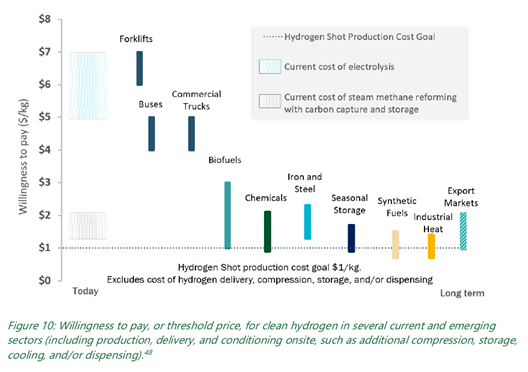
One of the biggest hurdles for clean hydrogen is high costs. The Department of Energy graph below says it all. Today, a kilogram of hydrogen produced by electrolysis costs around $5 to $7. When compared to the estimated $1 to $2 per kilogram for conventionally produced hydrogen with carbon capture and storage, it's easy to see why most industries likely won't adopt hydrogen produced via electrolysis until it becomes much cheaper.
.png "1260793b-18c5-4d39-bc85-abf1da7857c3-(1).png")
The federal government has enacted a slew of policies meant to lower the cost of clean hydrogen and address other market pressures. Those policies invest significantly in developing clean hydrogen at scale.
The federal government is beginning to roll out many of those critical programs. The Department of Energy will soon release $750 million in BIL funding for hydrogen projects in the Clean Hydrogen Electrolysis Program and for Clean Hydrogen Manufacturing and Recycling research and development:
Topic 1: Low Cost, High-Throughput Electrolyzer Manufacturing: Research, development, and demonstration (RD&D) that accelerates manufacturing innovations, so that electrolyzer stack manufacturers can achieve greater economies of scale.
Topic 2: Electrolyzer Component and Supply Chain Development: Research and development (R&D) of advanced components critical to accelerate the commercialization of electrolyzers.
Topic 3: Advanced Electrolyzer Technology and Component Development: R&D that develops materials, components, and designs that are at lower technology readiness levels (TRL) but show promise in achieving long-term cost, performance, and lifetime goals in next generation of electrolyzer technologies.
Topic 4: Fuel Cell Membrane Electrode Assembly and Stack Manufacturing and Automation: RD&D that accelerates fuel cell manufacturing innovation and scale-up by enabling diverse fuel cell manufacturer and supplier teams to flexibly address their greatest scale-up challenges and achieve economies of scale in medium- and heavy-duty vehicle (MDV/HDV) and cross-cutting applications.
Topic 5: Fuel Cell Supply Chain Development: R&D to address critical deficiencies in the domestic supply chain for MDV/HDV fuel cell materials and components.
Topic 6: Recovery and Recycling Consortium: Establish a single, broad-based nonprofit- or university-led consortium of industry, academia, and national labs to address a range of recovery, recycling, refurbishment, and reuse challenges for fuel cell and electrolyzer stacks and components.
The deadlines for this funding round are approaching. Concept papers were due on April 19, 2023, and full applications, on July 19, 2023.
These federal programs show that the Administration is aligned in backing clean hydrogen as a key decarbonization solution. In the next post, we'll take a closer look at developments in the Hydrogen Hubs program.
